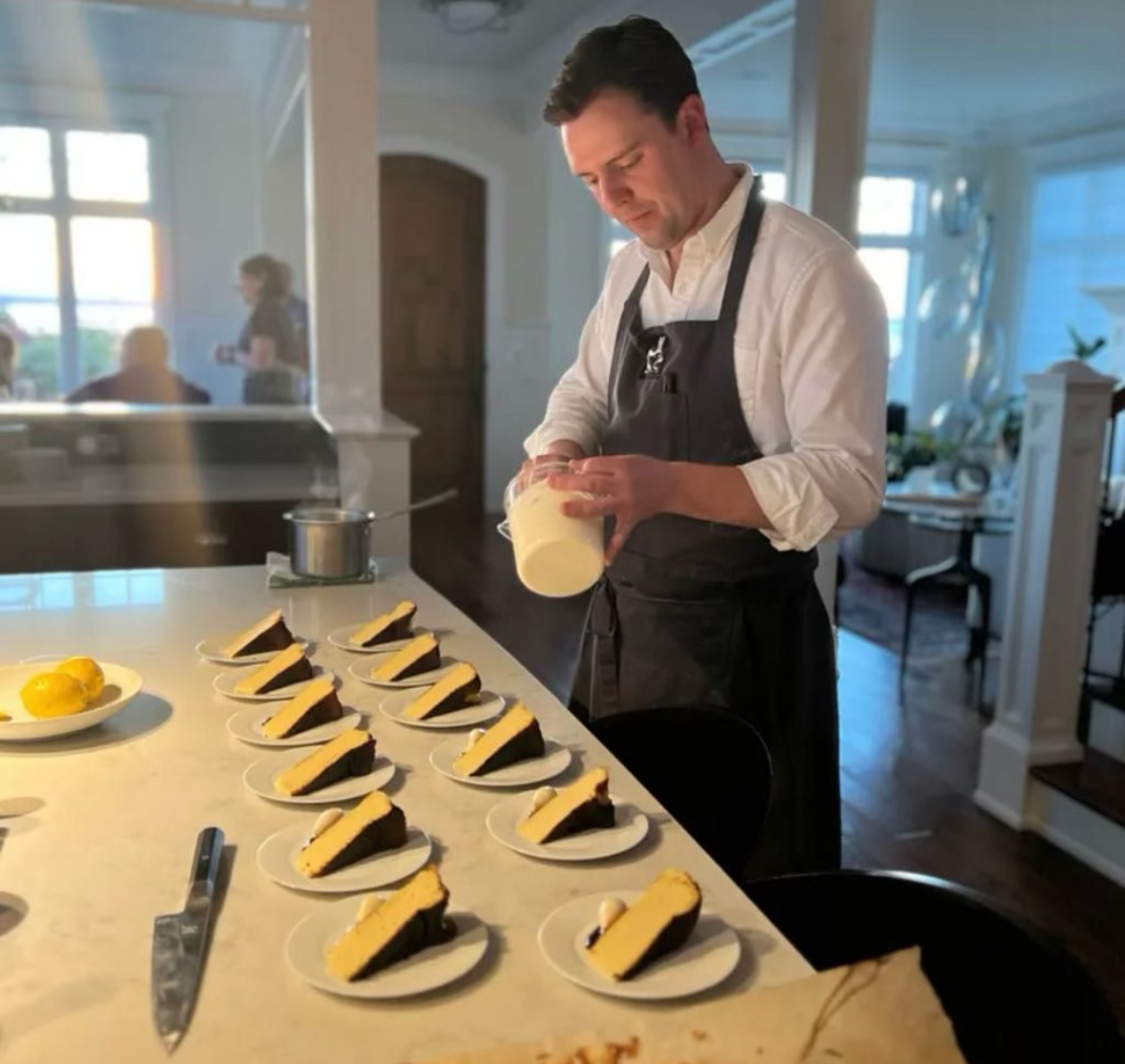
In the Kitchen · Ojai, CA
Serious kitchens, Catalan wood-fire technique, and a move to Ojai for the farms and the coast. Here's who's cooking for you and why the food tastes the way it does.
I grew up in Marblehead, Massachusetts — a sailing town on the North Shore where the ocean shaped everything, especially how I eat. Seafood wasn't an ingredient category. It was daily life. Striper off the rocks, lobster from the harbor, bluefish at midnight. That exposure to raw, unprocessed ingredients set the foundation for everything that came later.
I trained at Cafe Juanita in Kirkland, Washington — a James Beard-nominated restaurant where precision mattered and shortcuts didn't exist. Northern Italian technique, handmade pasta, sauces built from bones and time. That kitchen taught me discipline, consistency, and what it means to actually respect ingredients instead of just talking about it.
Then Tarsan I Jane, where everything changed. Years of Catalan wood-fire cooking — learning to read embers, to understand how white oak behaves differently from fruit wood, how smoke should enhance flavor without announcing itself. That technique fundamentally rewired how I approach heat. It carries through every menu I write.
I moved to Ojai for the farms, the coast, and the space to do this work on my own terms. No restaurant politics, no investor menus, no compromises between what's right for the food and what's right for the bottom line. Just the ingredients, the fire, and the people at the table.
Wood-fire cooking isn't a gimmick or a menu label. It's a fundamentally different relationship with heat. Gas gives you uniform temperature. Embers give you gradients — searing heat at the center, gentle warmth at the edges, and radiant energy that crisps skin and caramelizes sugars in ways a conventional oven can't replicate.
I cook primarily over white oak. It burns clean, holds temperature for hours, and produces a steady, even ember bed. Some dishes get direct flame — duck breast scored and crisped over live fire, whole branzino charred on the grill. Others sit at the periphery, slow-cooking in the residual heat. A single fire can handle an entire multi-course dinner if you understand the zones.
The Catalan tradition I trained in treats the hearth as the center of the kitchen, not an accessory. Everything passes through it — bread gets toasted over coals, stocks simmer in cast iron beside the embers, even desserts pick up a whisper of smoke. That's the difference between wood-fire as decoration and wood-fire as foundation.
I don't stockpile. I source the week of your dinner — sometimes the day of — because that's when ingredients are at their best. Ojai Valley produce picked that morning. Seafood from the Santa Barbara Channel when it's running. Dairy from small California creameries that don't distribute to grocery stores.
I have relationships with the farms I work with. Not in a marketing sense — I actually know the people growing the food. When something unexpected comes in — first-of-season Pixie tangerines, exceptional mushrooms after rain, a fisherman with day-boat catch — I'll work it into the menu. That flexibility is the whole point.
This approach means menus shift right up until service. A dish I planned on Tuesday might change by Thursday because something better showed up. The logic and the intent stay the same, but the specifics follow the ingredients, not the other way around. That's how you get food that actually tastes like the season instead of approximating it.
The best meals happen when you stop trying to impress people and start paying attention to what's actually in front of you.
I don't have packages. No "Gold" and "Platinum" tiers. No standard menu with optional upgrades. Every dinner starts with a conversation — about who's coming, what the occasion is, what you're hoping to feel at the end of the evening. The menu follows from that.
Dietary restrictions aren't an obstacle — they're part of the creative brief. I live with my own dietary constraints, so I understand what it takes to make restricted-diet cooking genuinely exciting rather than just compliant. Gluten-free, vegan, autoimmune protocols — I approach these the same way I approach any other menu: with the same ambition and the same respect for flavor.
This work is personal. I'm not running a catering company or managing a team of sous chefs. I do the conversation, the sourcing, the cooking, the cleanup. One chef, one dinner, full attention. That constraint is also the reason the food is good — nothing falls through the cracks when one person owns every step.
Tell me about the occasion, who's coming, and what you're hoping for. I'll take it from there.